sextant

sextant
sextant is an instrument used
to measure the angle between
any two visible objects. Its
primary use is to determine the
angle between a celestial object
and the horizon which is known
as the object's altitude. Making
this measurement is known as
sighting the object, shooting the
object, or taking a sight and it is
an essential part of celestial
navigation. The angle, and the
time when it was measured, can
be used to calculate a position
line on a nautical or aeronautical
chart. Common uses of the
sextant include sighting the sun
at solar noon and sighting Polaris
at night, to find one's latitude (in
northern latitudes). A sextant
can also be held horizontally to
measure the angle between any
two landmarks which allows for
calculation of a position on a
chart. A sextant can also be used
to measure the lunar distance
between the moon and another
celestial object (e.g., star, planet)
in order to determine Greenwich
time which is important because
it can then be used to determine
the longitude.
The scale of a sextant has a
length of ⅙ of a turn (60°);
hence the sextant's name
(sextāns, -antis is the Latin word
for "one sixth"). An octant is a
similar device with a shorter scale
(⅛ turn, or 45°), whereas a
quintant (⅕ turn, or 72°) and a
quadrant (¼ turn, or 90°) have
longer scales.
Sir Isaac Newton (1643–1727)
invented the principle of the
doubly reflecting navigation
instrument (a reflecting quadrant
—see Octant (instrument)), but
never published it. Two men
independently developed the
octant around 1730: John Hadley
(1682–1744), an English
mathematician, and Thomas
Godfrey (1704–1749), a glazier in
Philadelphia. John Bird made the
first sextant in 1757. The octant
and later the sextant, replaced
the Davis quadrant as the main
instrument for navigation.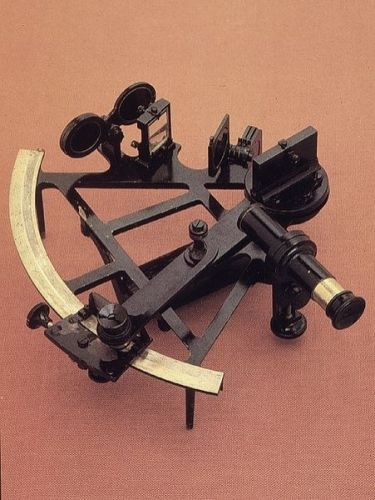
 MERCHANT NAVY FORUM


